Effective April 2026, the sequencing of the Background reading for Bugcount Solids tests has changed. See this article for details.
Effective January 2026, the Deposit & Surface Analysis family of test kits has been renamed BugCount Solids. See this article for details.
The Bugcount Solids test kit measures total ATP (tATP) in deposits, sludges, and surface swabs to provide a direct, real-time view of biofilm activity and fouling potential across equipment and assets. Results help you target cleaning, verify remediation, and prevent corrosion, plugging, and unplanned downtime.
There are three ways to use it:
Surface Swab: Swab a measured area to collect biofilm, then extract ATP.
Measured Deposit: Collect and measure a deposit, then extract ATP.
Biofilm Collector: Extract ATP from a collection device such as a corrosion coupon.
Key terms
ATP: Adenosine triphosphate, energy molecule of living cells.
tATP (Total ATP): All ATP in the sample (living + dead cells).
RLU: Relative Light Units, the measurement of luminescence.
ATP1 RLU: Calibration signal from UltraCheck 1.
tATP RLU: Sample result for total ATP.
Background RLU: Baseline signal measured from Luminase only.
Run this test with the Relay™ app
Relay™ is your tool to easily calculate, organize, and share results. Access is included with your purchase.
If you are new to this test, please refer to the Full Method to follow the steps in detail.
Log in to Relay™and select RUN TESTS at the site you are working with.
Rehydrate Luminasewith contents of the Buffer vial. Mix, and wait 5 minutes.
Background: Add 100µL of Luminase to a clean test tube and READ Background RLU.
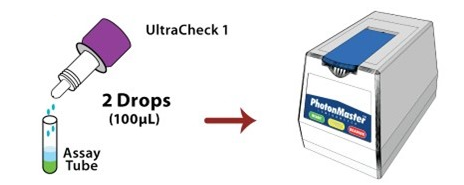
Calibration: Mix 2 drops of UltraCheck 1 to the tube and READ ATP1 RLU.
Sample preparation and extraction:
Swab: Swab your surface with LumiSolve. Insert swab into UltraLyse 7 tube. Cap, mix, and wait 5 minutes.
Deposit: Add 1g of sample to UltraLyse 7 tube. Cap, mix, and wait 5 minutes.
Biofilm: Submerge the collection device in UltraLyse 7 tube. Cap, mix, and wait 5 minutes.
Dilution: Transfer 1mL of the UltraLyse 7 solution to an UltraLute tube and mix.
Assay: Add 100µL of UltraLute solution to a tube with 100µL of Luminase. Swirl and read tATP RLU.
Save: In Relay™, select SAVE TEST.
Component list
Kit component
Storage
Luminase enzyme & Buffer vials, 3mL
20°C (68°F)
UltraCheck 1 dropper bottle, 2.5mL
20°C (68°F)
UltraLyse 7 (extraction) tube, 5mL
20°C (68°F)
UltraLute (dilution) tube, 9mL
20°C (68°F)
LumiSolve bottle, 30mL
20°C (68°F)
Sterile swabs
100—1,250µL blue pipet tips, 96 rack
1—200µL yellow pipet tips, 96 rack
12x55mm test tubes
Disposable bulb pipets, 5mL
Note: Kit components may vary in appearance, packaging, labeling, or manufacturer periodically. These changes do not affect their intended use. Use only components supplied or approved by Luminultra.
If you are new to Relay™, follow the guides to first create a site and sample location.
Connect to your luminometer, then select RUN TESTS to begin a new test.
As you work through these test kit instructions, you can initiate RLU readings directly within Relay™ by selecting READ on any input. Once all inputs are entered, your results will automatically calculate.
1.2 Rehydrate the Luminase enzyme
Gently mix the Buffer and Luminase enzyme.
Wait 5 minutes for solution to dissolve.
After rehydration, keep Luminase refrigerated or frozen; it stays effective for 2–4 weeks at 4°C (39°F) or 3–6 months when frozen between uses. Before testing, let it thaw and reach room temperature (takes about 1 hour). Do not apply direct heat to warm it faster. For more details, visit my.luminultra.com.
1.3 Background measurement
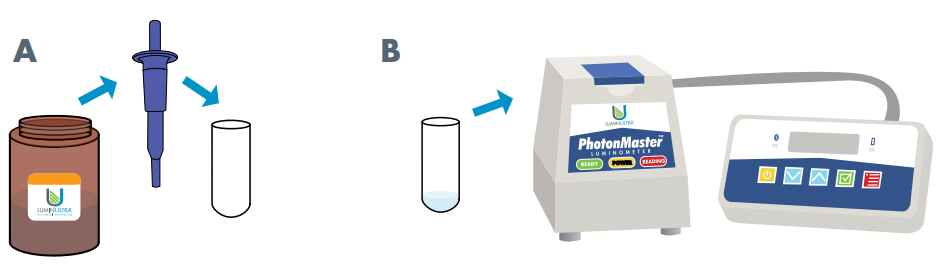
Pipet 100µL of the Luminase into a new, clean 12x55mm test tube.
Put this test tube into your luminometer and take the Background RLU reading (select READ).
This tube can then be used for your first sample assay on the next step.
If the Background RLU is above 20 RLU, this indicates that some external factors (light, contamination) may be influencing your results. LuminUltra offers cleaning kits for your luminometer. Please contact us to discuss.
1.4 Calibration using UltraCheck 1 (ATP1 RLU)
Hold theUltraCheck 1 bottle vertical and add 2 drops (100µL) to the test tube containing Luminase.
Swirl the tube, place it in the luminometer, and take the ATP1 RLU reading (select READ) within 10 seconds.
If ATP1 RLU ≤ 5,000 rehydrate a new bottle of Luminase.
Once UltraCheck 1 is opened, it must be used within 3 months. After 3 months, discard and use a new bottle.
2. Sample preparation
Option 1: Surface swab
Obtain a new Sterile Swab and wet with LumiSolve.Swab a surface area of approximately 5x5cm (2x2in).
Insert swab in a 5mL UltraLyse 7 (extraction) tube. Cap and mix the contents of the tube.
To increase analysis sensitivity, increase the swabbed surface area.
Option 2: Measured deposit
Obtain a portion of the deposit and weigh 1g of sample.
Add this to a 5mL UltraLyse 7 (extraction) tube.
Cap and mix the contents of the tube vigorously to disperse the deposit throughout the fluid.
A measured volume of deposit (e.g. 1mL) can also be used instead of a weighed amount.
Option 3: Biofilm collector
Obtain a biofilm collection device from the process and shake gently to remove excess fluid.
Note the area of all biofilm-containing surfaces on the device and place it into a 5mL UltraLyse 7 (extraction) tube.
Cap and mix the contents of the tube vigorously to disperse the deposit throughout the fluid.
Attempt to test the biofilm collection device as quickly as possible following removal from process fluid.
3. Total ATP analysis (tATP RLU)
3.1 Extraction
Allow at least 5 minutes for ATP extraction in the 5mL UltraLyse 7 (extraction) tube.
When using the biofilm collector method, ensure the device is submerged in the UltraLyse 7 during incubation.
3.2 Dilution
Transfer 1mL from the UltraLyse 7 (extraction) tube to a 9mL UltraLute (dilution) tube.
Cap and invert three times to mix.
3.4 Assay
Combine 100µL of the UltraLute (dilution) solution with 100µL of Luminase.
For your first sample, you can add the UltraLute (dilution) solution directly to the test tube you used for the Background measurement.
For each subsequent sample, add 100µL of the UltraLute (dilution) solution and 100µL of Luminase to a new 12x55mm test tube, using new pipet tips for each reagent and each sample.
Swirl the tube, place it in the luminometer, and take the cATP RLU reading (select READ) within 10 seconds.
In Relay™, select SAVE TEST.
4. Analysis
Calculations
Tip: Relay™ does the work For you
When all inputs are entered in Relay’sRun tests workflow, the results will calculate automatically. Select Save Test to catalog and share your results with your team.
You may also divide the result by the number of days the biofilm has had to evolve to obtain a growth rate.
Data Interpretation Guidelines
ATP-based measurements are extremely sensitive to changes in total microbial quantity. In general, processes will have the best microbial control when tATP is minimized.
It is recommend to compare surface/deposit results to bulk fluid results. Good control of biofilm is generally achieved when the biofilm/fluid ratio is <10x, and corrective action is required at levels of 100x or above:
Application
Good Control (pg tATP/cm2 or g)
Preventive Action (pg tATP/cm2 or g)
Corrective Action (pg tATP/cm2 or g)
Potable & Sanitary Water
<10
10–1,000
>1,000
Raw, Cooling & Process Water (Oxidizing Biocide)
<100
100–10,000
>10,000
Cooling, Process, Bottom & Oilfield Water (Non-Oxidizing Biocide)
<1,000
1,000–100,000
>100,000
Bulk Fluid-to-Biofilm Ratio
<10x
10x–100x
>100x
Biological Filter Media
Process dependent
Our guidance thresholds (e.g., 10 pg/mL) are drawn from broad industry experience with microbial contamination in similar systems. We encourage you to build your own baseline by comparing ATP results with on-the-ground observations. This creates thresholds tailored to your operation—so your team can act with confidence in every decision.
Support
Troubleshooting
Issue
Recommendation
Readings are lower than expected values
Ensure reagents are not expired (expiry information can be found on reagent vials). Ensure reagents are being stored properly (storage information can be found on reagent vials)
Background readings are higher than expected
If using the Bugcount® One ATP Analyzer, replace the chamber using the Bugcount® One ATP Analyzer Maintenance Kit. If using the PhotonMaster, quarterly cleaning (LCK) is recommended. Annual linearity verification is also recommended using the Luminometer Standardization Kit. All kits are available for purchase from Luminultra.