Effective January 2026, this kit replaces the QuenchGone Organic Modified (QGOM) and LifeCheck Planktonic (with Rinse) kits.
For details on LifeCheck reagent alignment, see this article.
For details on QGOM’s transition to Bugcount Fluids, see this article.
This test kit measures cellular ATP (cATP) to quantify total living biomass in hydrocarbon-based samples. By providing rapid, reliable insight into microbial growth, it helps you detect contamination early, prevent corrosion and fouling, and protect critical assets in energy and industrial systems.
Key terms
ATP: Adenosine triphosphate, energy molecule of living cells.
cATP (cellular ATP): ATP inside living cells, representing active biomass.
RLU: Relative Light Units, the measurement of luminescence.
ATP1 RLU: Calibration signal from UltraCheck 1.
cATP RLU: Sample result for cellular ATP.
Background RLU: Baseline signal measured from Luminase only.
Volume: Amount of sample filtered, in mL.
Run this test with the Relay™ app
Relay™ is your tool to easily calculate, organize, and share results. Access is included with your purchase.
If you are new to Relay™, follow the guides to first create a site and sample location.
Connect to your luminometer, then select RUN TESTS to begin a new test.
As you work through these test kit instructions, you can initiate RLU readings directly within Relay™ by selecting READ on any input. Once all inputs are entered, your results will automatically calculate.
1.2 Rehydrate the Luminase enzyme
Gently mix the Buffer and Luminase enzyme.
Wait 5 minutes for solution to dissolve.
After rehydration, keep Luminase refrigerated or frozen; it stays effective for 2–4 weeks at 4°C (39°F) or 3–6 months when frozen between uses. Before testing, let it thaw and reach room temperature (takes about 1 hour). Do not apply direct heat to warm it faster. For more details, visit my.luminultra.com.
1.3 Background measurement
Add 100µL of the Luminase into a new, clean 12x55mm test tube using the 100µL pipettor and a yellow pipet tip.
Put this test tube into your luminometer and take the Background RLU reading (select READ).
If the Background RLU is above 20 RLU, this indicates that some external factors (light, contamination) may be influencing your results. LuminUltra offers cleaning kits for your luminometer. Please contact us to discuss.
1.4 Calibration using UltraCheck 1 (ATP1 RLU)
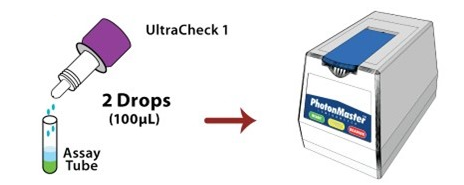
Hold the UltraCheck 1 bottle vertical and add 2 drops (100µL) to the test tube containing Luminase.
Swirl the tube, place it in the luminometer, and take the ATP1 RLU reading (select READ) within 10 seconds.
If ATP1 RLU ≤ 5,000 rehydrate a new bottle of Luminase.
Once UltraCheck 1 is opened, it must be used within 3 months. After 3 months, discard and use a new bottle.
2. Cellular ATP analysis (cATP RLU)
2.1 Filtration
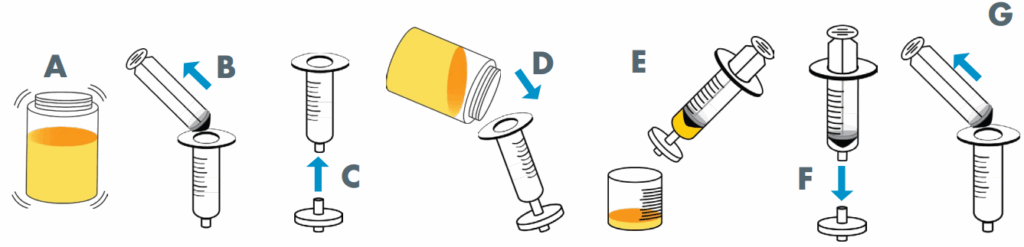
Mix sample well.
Remove the plunger from the syringe.
Attach a new syringe filter.
Pour the recommended volume of sample into the syringe, and record the amount used as Volume.
Place the plunger back into the syringe and slowly push sample through the filter into waste receptacle.
Detach the filter.
Remove the plunger.
Always remove the filter before pulling the plunger back. This prevents air from being drawn through the filter, keeping captured microbes in place and ensuring accurate ATP recovery and reagent performance.
2.2 Washing and drying
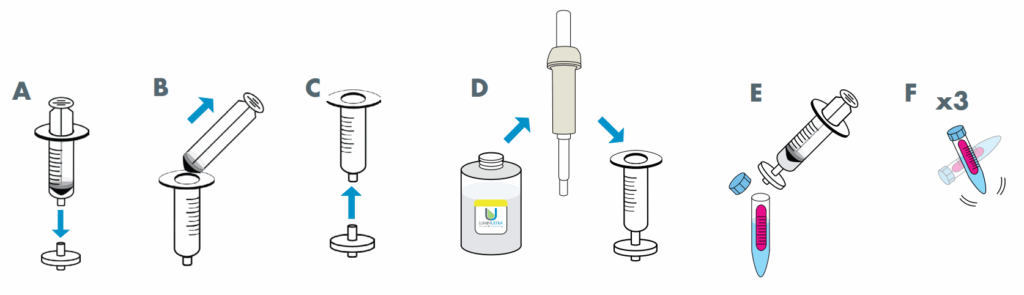
Re-attach the filter to the syringe.
Using a disposable bulb pipet, add 5mL of LumiClean to the syringe barrel.
Push the LumiClean slowly through the filter into a waste container. Continue to push the plunger all the way to the bottom, which will dry the filter.
2.3 Extraction
This step breaks open microbial cells to release ATP.
Remove the filter from the syringe.
Remove the plunger from the syringe.
Re-attach the filter.
Add 1 mL of UltraLyse 7 to the syringe barrel using the 1mL pipettor.
Pass it slowly through the filter and collect in a new 9mL UltraLute (dilution) tube.
Cap and invert three times to mix.
2.5 Assay
Add 100µL of UltraLute (dilution) solution to a new 12x55mm test tube.
And 100µL of Luminase to the tube.
Swirl the tube, place it in the luminometer, and take the cATP RLU reading (select READ) within 10 seconds.
In Relay™, select SAVE TEST.
3. Analysis
Calculations
Tip: Relay™ does the work For you
When all inputs are entered in Relay’sRun tests workflow, the results will calculate automatically. Select Save Test to catalog and share your results with your team.
Oilfield produced waters, source fluids, and brines
<100
100–1,000
>1,000
Metalworking fluids, fire-retardant lubricants
<1,000
1,000–10,000
>10,000
Our guidance thresholds (e.g., 100 pg/mL) are drawn from broad industry experience with microbial contamination in similar systems. We encourage you to build your own baseline by comparing ATP results with on-the-ground observations. This creates thresholds tailored to your operation—so your team can act with confidence in every decision.
Support
Troubleshooting
Issue
Recommendation
Readings are lower than expected values
Ensure reagents are not expired (expiry information can be found on reagent vials). Ensure reagents are being stored properly (storage information can be found on reagent vials)
Background readings are higher than expected
Check if your Luminometer needs to be cleaned. Quarterly cleaning (LCK) and annual linearity verification (LSK) is recommended. Cleaning and maintenance kits are available for purchase from Luminultra.