The AccuLight Basic Test Kit is a simplified test that measures total ATP (tATP)—with the option to also measure free ATP (fATP)—in cooling and process water systems.
Key terms
ATP: Adenosine triphosphate, energy molecule of living cells.
tATP (Total ATP): ATP either inside living cells, or released from dead cells.
fATP (Free ATP): Freely-available, extra-cellular ATP originating from dead cells. A sub-set of Dissolved ATP (dATP).
cATP (Cellular ATP): ATP inside living cells, representing active biomass.
RLU: Relative Light Units, the measurement of luminescence.
RLU ATP1: Calibration signal from UltraCheck 1.
RLU tATP: Sample result for total ATP.
RLU fATP: Sample result for free ATP.
Run this test with the Relay™ app
Relay™ is your tool to easily calculate, organize, and share results. Access is included with your purchase.
If you are new to Relay™, follow the guides to first create a site and sample location.
Connect to your luminometer, then select RUN TESTS to begin a new test.
As you work through these test kit instructions, you can initiate RLU readings directly within Relay™ by selecting READ on any input. Once all inputs are entered, your results will automatically calculate.
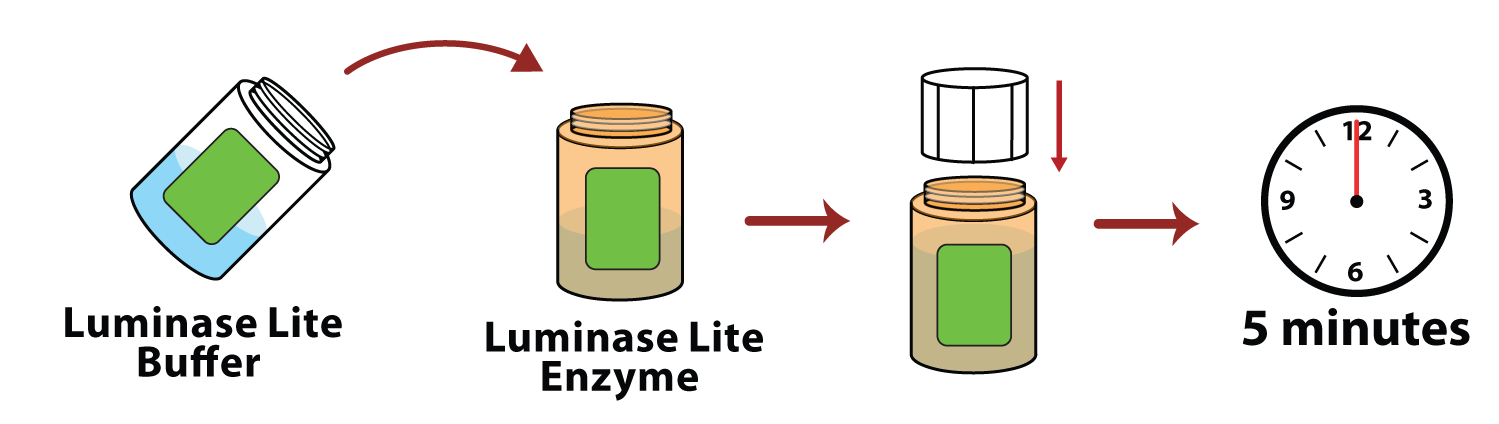
1.2 Rehydrate the Luminase Lite enzyme
Gently mix the Buffer Lite and Luminase Liteenzyme.
Wait 5 minutes for solution to dissolve.
After rehydration, keep Luminase refrigerated or frozen; it stays effective for 2–4 weeks at 4°C (39°F) or 3–6 months when frozen between uses. Before testing, let it thaw and reach room temperature (takes about 1 hour). Do not apply direct heat to warm it faster. For more details, visit my.luminultra.com.
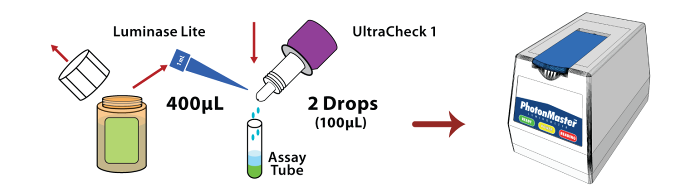
1.3 Calibration using UltraCheck 1 (RLU ATP1)
Hold the UltraCheck 1 bottle vertical and add 2 drops (100µL) of it to a 12x55mm test tube.
Pipet 400µL of Luminase Lite into the test tube.
Swirl the tube, place it in the luminometer, and take the RLU ATP1 reading (select READ) within 10 seconds.
If RLU ATP1 ≤ 1,000 rehydrate a new bottle of Luminase.
Calibration generally only needs to be done once per day (not with every test).
Once UltraCheck 1 is opened, it must be used within 3 months. After 3 months, discard and use a new bottle.
2. Total ATP analysis (RLU tATP)
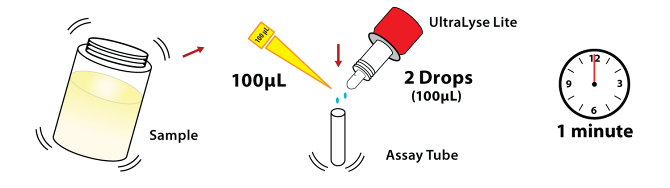
2.1 Extraction
Mix sample well.
Using a new pipet tip, pipet 100µL of sample into a new 12x55mm test tube.
Holding the bottle vertical, add 2 drops (100μL) of UltraLyse Lite.
Swirl the tube gently to mix contents.
Allow 1 minute for extraction.
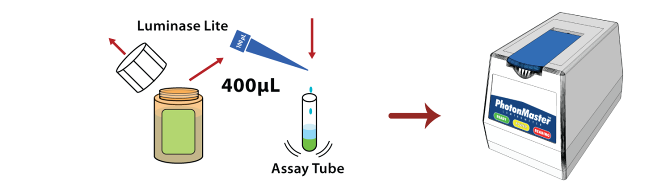
2.2 Assay
Add 400μL of Luminase Lite to the test tube from the previous step.
Swirl the tube, place it in the luminometer, and take the RLU tATP reading (select READ) within 10 seconds.
In Relay™, select SAVE TEST.
3. Optional: Free ATP analysis (RLU fATP)
3.1 Assay
Mix sample well.
Using a new pipet tip, pipet 100μL of sample into a new 12x55mm test tube.
Add 400μL of Luminase Lite to the tube.
Swirl the tube, place it in the luminometer, and take the RLU fATP reading (select READ) within 10 seconds.
In Relay™, select SAVE TEST.
4. Analysis
Calculations
Tip: Relay™ does the work For you
When all inputs are entered in Relay’sRun tests workflow, the results will calculate automatically. Select Save Test to catalog and share your results with your team.
ATP-based measurements are extremely sensitive to changes in total microbial quantity. In general, processes will have the best microbial control when tATP is minimized.
When utilizing ATP test kits it is important to remember that every process is different. During audits, relative comparisons from point to point are a reliable means to assess your process, while for daily monitoring it is important to establish a baseline trend before making control decisions.
To get started, LuminUltra provides the following guidelines in units of pg tATP/mL.
Sample Type
Good Control (pg cATP/mL)
Preventative (pg cATP/mL)
Corrective Action (pg cATP/mL)
Cooling & Process Water Oxidizing Biocides
<10
10–100
>100
Cooling & Process Water Non-Oxidizing Biocides or Non-Chemical Treatment
<100
100–1,000
>1,000
Papermaking Product Quality (Newsprint, Fine Papers)
<1,000
1,000–10,000
>10,000
Papermaking Odor Control (Paperboard, Recycle Water)
<10,000
10,000–100,000
>100,000
When free ATP (fATP) is measured, subtract this value from Total ATP (tATP) prior to data analysis and interpretation.
Our guidance thresholds (e.g., 10 pg/mL) are drawn from broad industry experience with microbial contamination in similar systems. We encourage you to build your own baseline by comparing ATP results with on-the-ground observations. This creates thresholds tailored to your operation—so your team can act with confidence in every decision.
Support
Troubleshooting
Issue
Recommendation
Readings are lower than expected values
Ensure reagents are not expired (expiry information can be found on reagent vials). Ensure reagents are being stored properly (storage information can be found on reagent vials)
Background readings are higher than expected
Check if your Luminometer needs to be cleaned. Quarterly cleaning (LCK kit) and annual linearity verification (LSK kit) is recommended. Cleaning and maintenance kits are available for purchase from LuminUltra.