Effective March 2026, the QuenchGone21 Wastewater family of test kits has been renamed Bugcount Wastewater. See this article for details.
This kit measures total, dissolved and cellular ATP (tATP, dATP, cATP) to provide a direct, real-time view of microbial health and stress within wastewater processes. Results empower operators to protect performance, maintain compliance and prevent costly failures.
With Attached Growth add-on
This kit measures total, dissolved and cellular ATP (tATP, dATP, cATP) to provide a direct, real-time view of microbial health and stress within wastewater processes. Results empower operators to protect performance, maintain compliance and prevent costly failures.
Attached Growth ATP measures ATP associated with attached microorganisms in attached growth systems, and is available with the QuenchGone 21 Wastewater Advanced add-on.
With Floc-Bulking add-on
This kit measures total, dissolved and cellular ATP (tATP, dATP, cATP) to provide a direct, real-time view of microbial health and stress within wastewater processes. Results empower operators to protect performance, maintain compliance and prevent costly failures.
The Floc-Bulking ATP measures ATP associated with bulking floc in suspended growth aerobic bioreactor samples, and is available with the QuenchGone 21 Wastewater Advanced add-on.
Key terms
ATP: Adenosine triphosphate, energy molecule of living cells.
tATP (Total ATP): All ATP in the sample (living + dead cells).
dATP (Dissolved ATP): ATP released from dead or compromised cells.
cATP (Cellular ATP): ATP inside living cells, representing active biomass.
RLU: Relative Light Units (measurement from luminometer).
ATP1 RLU: Calibration signal from UltraCheck 1.
tATP RLU: Sample result for total ATP.
dATP RLU: Sample result for dissolved ATP.
fbATP (Floc-Bulking ATP): ATP from bulking floc in suspended-growth aerobic systems.
agATP (Attached Growth ATP): ATP from microorganisms attached in fixed-film systems.
fbATP RLU: Sample result for floc-bulking ATP.
agATP RLU: Sample result for attached growth ATP.
AVSS (Activated Volatile Suspended Solids): Mass of living organisms in the sample.
ABR (Active Biomass Ratio): Share of suspended solids that are living microorganisms.
BSI (Biomass Stress Index): Stress level of the microbial community.
Specific fbATP (s-fbATP): Relative quantity of bulking floc to total floc. As this number increases, the risk of bulking conditions increases.
Specific agATP (s-agATP): Relative quantity of attached microorganisms to total microorganisms. As this number decreases, the risk of process failure due to biomass detachment increases.
Run this test with the Relay™ app
Relay™ is your tool to easily calculate, organize, and share results. Access is included with your purchase.
If you are new to this test, please refer to the Full Method to follow the steps in detail.
Log in to Relay™and select RUN TESTS at the site you are working with.
Rehydrate LuminaseWwith contents of the Buffer vial. Mix, and wait 5 minutes.
Calibration: Mix 2 drops of UltraCheck1 and 300µL of LuminaseW, and READ ATP1 RLU.
Extraction: Mix 1mL of sample into the UltraLyse 3021 tube. Wait 1 minute.
Dilution: Pour UltraLyse 3021 solution into a new UltraLute/Resin tube. Transfer between the tubes >3 times, then allow beads to settle.
tATP assay: Add 100µL of UltraLute/Resin solution and 300µL of LuminaseW to a clean test tube. Swirl and READ tATP RLU.
Dilution: Add 100µL of sample to a LumiSolve tube. Mix and wait 1 minute.
dATP assay: Add 100µL of the LumiSolve solution and 300µL of LuminaseW to a clean test tube with. Swirl and READ dATP RLU.
Floc-bulking:
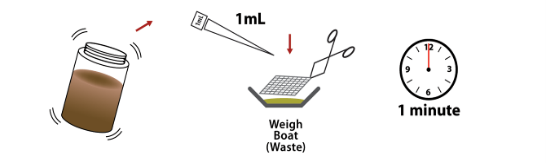
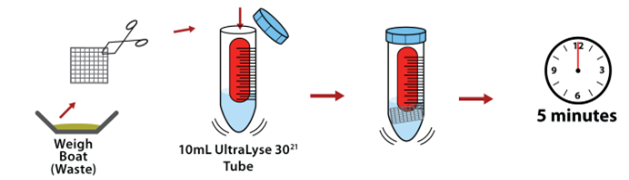
Pipet 1mL of sample onto a new piece of mesh. Filter for 1 minute, then transfer the mesh into a new UltraLyse 3021 tube. Mix and wait 5 minutes.
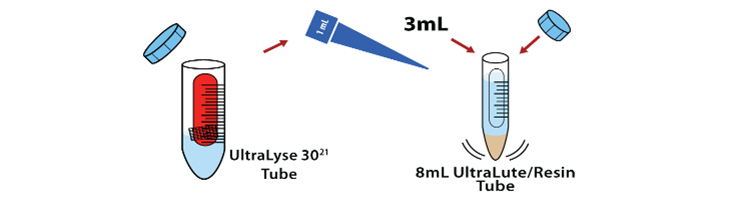
Add 3mL of the UltraLyse 3021 solution to a new UltraLute/Resin tube. Cap and invert 3x, and allow beads to settle.
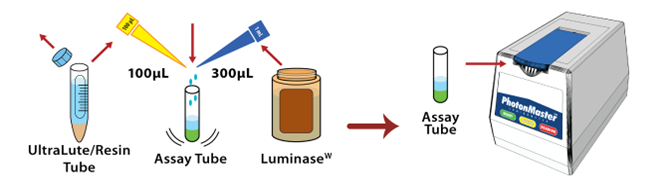
Add 100µL of UltraLute/Resin solution to a clean test tube with 300µL of LuminaseW. Swirl and READ fbATP RLU.
Attached growth:
Add 1g of sample or 1-2 media discs to new UltraLyse 3021 tube. Mix, wait 5 minutes.
Add 3mL of the UltraLyse 3021 solution to a new UltraLute/Resin tube. Cap and invert 3x, and allow beads to settle.
Add 100µL of UltraLute/Resin solution to a clean test tube with 300µL of LuminaseW. Swirl and READ agATP RLU.
Save: In Relay™, select SAVE TEST.
Component list
Kit component
Storage
LuminaseW enzyme & Buffer vials, 3mL
20°C (68°F)
UltraCheck 1 dropper bottle, 2.5mL
20°C (68°F)
UltraLyse 3021 (extraction) tube, 2mL
20°C (68°F)
UltraLute/Resin (dilution) tube, 8mL
20°C (68°F)
LumiSolve (stabilizer) tube, 10mL
20°C (68°F)
UltraLyse 3021 (extraction) tube, 10mL
20°C (68°F)
UltraLyse 3021 (extraction) tube, 10mL
20°C (68°F)
100µL–1,250µL blue pipet tips, 96 rack
100µL to 1,000µL wide-mouth pipet tips, 96 rack
1µL–200µL yellow pipet tips, 96 rack
12x55mm test tubes
2″ x 2″ mesh squares, 250µm
2″ x 2″ mesh squares, 250µm
1.5″ x 1.5″ weigh boat
1.5″ x 1.5″ weigh boat
Scissor-type forceps
Scissor-type forceps
Specimen container, 120mL
Specimen container, 120mL
Note: Kit components may vary in appearance, packaging, labeling, or manufacturer periodically. These changes do not affect their intended use. Use only components supplied or approved by Luminultra.
If you are new to Relay™, follow the guides to first create a site and sample location.
Connect to your luminometer, then select RUN TESTS to begin a new test.
As you work through these test kit instructions, you can initiate RLU readings directly within Relay™ by selecting READ on any input. Once all inputs are entered, your results will automatically calculate.
1.2 Rehydrate the LuminaseW enzyme
Gently mix the Buffer and LuminaseW enzyme.
Wait 5 minutes for solution to dissolve.
After rehydration, keep Luminase refrigerated or frozen; it stays effective for 2–4 weeks at 4°C (39°F) or 3–6 months when frozen between uses. Before testing, let it thaw and reach room temperature (takes about 1 hour). Do not apply direct heat to warm it faster. For more details, visit my.luminultra.com.
1.3 Calibration using UltraCheck 1 (ATP1 RLU)
Hold the UltraCheck 1 bottle vertical and add 2 drops (100µL) of it to a 12x55mm test tube.
Pipet 300µL of LuminaseW into the tube.
Swirl the tube, place it in the luminometer, and take the ATP1 RLU reading (select READ) within 10 seconds.
If ATP1 RLU ≤ 500 rehydrate a new bottle of LuminaseW.
Once UltraCheck 1 is opened, it must be used within 3 months. After 3 months, discard and use a new bottle.
2. Total ATP analysis (tATP RLU)
2.1 Extraction
Mix sample well and test before the sample settles.
Using a wide-mouth pipet tip, add 1mL of sample to a 2mL UltraLyse 3021 (extraction) tube.
Cap, mix and allow 1 minute for incubation.
2.2 Dilution
Pour the UltraLyse 3021 (extraction) tube contents into a new 8mL UltraLute/Resin (dilution) tube.
Transfer the mixture between the tubes at least 3 times. Cap, mix and allow beads to settle.
2.3 Assay
Add 100µL of the UltraLute/Resin (dilution) solution to a 12x55mm test tube.
Use a new pipet tip to add 300µL of LuminaseW.
Swirl the tube, place it in the luminometer, and take the tATP RLU reading (select READ) within 10 seconds.
3. Dissolved ATP analysis (dATP RLU)
3.1 Dilution
Gently mix the sample and test before the sample settles.
Add 100µL of sample to a 10mL LumiSolve tube.
Cap and invert at least 3 times to mix, then allow 1 minute for incubation.
3.2 Assay
Add 100µL of the 10mL LumiSolve solution to a 12x55mm test tube.
Use a new pipet tip to add 300µL of LuminaseW.
Swirl the tube, place it in the luminometer, and take the dATP RLU reading (select READ) within 10 seconds.
In Relay™, select SAVE TEST.
4. Floc-bulking ATP analysis (fbATP RLU)
4.1 Filtration
Using the forceps, place a new piece of the 2”x2” 250µm mesh over a new 1.5”x1.5” weigh boat.
Pipet 1mL of the sample onto the mesh and collect the filtrate. Allow 1 minute for filtration.
4.2 Extraction
Carefully transfer the mesh into a new 10mL UltraLyse 3021 tube.
Cap, mix and allow 5 minutes for extraction.
4.3 Dilution
Using a new pipet tip, transfer 3mL (3 x 1mL) of the contents from the UltraLyse 3021 tube into a new 8mL UltraLute/Resin tube.
Cap, invert three times, and allow beads to settle.
4.4 Assay
Add 100µL of the UltraLute/Resin Tube solution to a 12x55mm test tube.
Use a new pipet tip to add 300µL of LuminaseW.
Swirl the tube, place it in the luminometer, and take the fbATP RLU reading (select READ) within 10 seconds.
In Relay™, select SAVE TEST.
4. Attached growth ATP analysis (agATP RLU)
4.1 Extraction
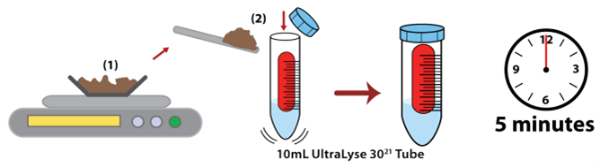
Measure 1g of media sample and add it to a new 10mL UltraLyse 3021 tube.
Cap, mix and allow 5 minutes for extraction.
OR
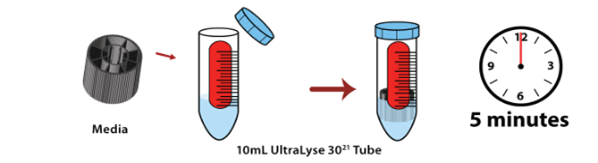
Add 1-2 pieces of media discs to the 10mL UltraLyse 3021 tube.
Cap, mix and allow 5 minutes for extraction.
4.2 Dilution
Using a new pipet tip, transfer 3mL (3 x 1mL) of the contents from the UltraLyse 3021 tube into a new 8mL UltraLute/Resin tube.
Cap, invert three times, and allow beads to settle.
4.3 Assay
Add 100µL of the UltraLute/Resin Tube solution to a 12x55mm test tube.
Use a new pipet tip to add 300µL of LuminaseW.
Swirl the tube, place it in the luminometer, and take the agATP RLU reading (select READ) within 10 seconds.
In Relay™, select SAVE TEST.
4. Analysis
5. Analysis
5. Analysis
Tip: Relay™ does the work For you
When all inputs are entered in Relay’sRun tests workflow, the results will calculate automatically. Select Save Test to catalog and share your results with your team.
Preliminary Calculations
Use these results to determine Key Process Indicators in the next section.
When the computed dATP (ng/mL) > tATP (ng/mL), first confirm that the result is not due to inhibition by re-testing tATP using 0.1mL of sample rather than 1mL.
It is important to stress that in situations of dATP (ng/mL) = tATP (ng/mL), it does not mean that the entire microbiological population is dead and are therefore incapable of performing work functions (e.g. BOD removal). It means that in their current state, the microorganisms are severely compromised to the degree that their weakened cell membranes are lysed and their ATP is released even when exposed to a mild buffer such as LumiSolve. These occurrences should be taken as an alert to take action immediately to correct the stress (e.g. catastrophic loss of nutrients or oxygen, severe toxicity). Sustained stress at this level can result in complete failure of a bioreactor.
The magnitude of cATP will depend on bioreactor configuration. In general, deviation from typical values by +/- 25% to 50% should be considered a preventative guideline and +/- 50% or greater should be considered corrective.
These interpretation guidelines are designed for generic risk management guidance only. Users are encouraged to establish their own control ranges on which to base process decisions. LuminUltra and its affiliates do not accept any liability for any decision or assessment taken or made as a consequence of using this test kit.
Support
Troubleshooting
Issue
Recommendation
Readings are lower than expected values
Ensure reagents are not expired (expiry information can be found on reagent vials). Ensure reagents are being stored properly (storage information can be found on reagent vials)
Background readings are higher than expected
If using the Bugcount® One ATP Analyzer, replace the chamber using the Bugcount® One ATP Analyzer Maintenance Kit. If using the PhotonMaster, quarterly cleaning (LCK) is recommended. Annual linearity verification is also recommended using the Luminometer Standardization Kit. All kits are available for purchase from Luminultra.